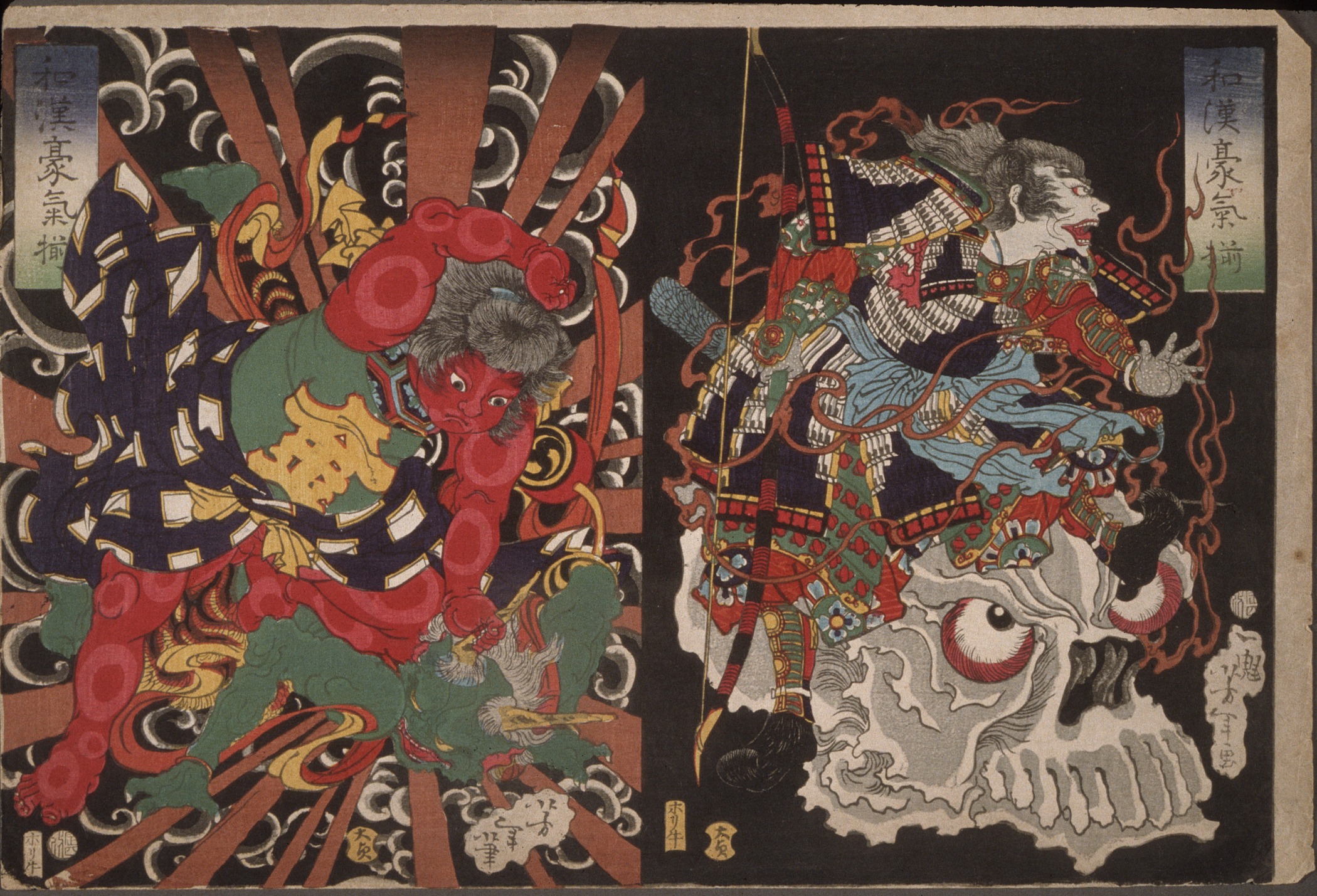
The Island of Thunder: A Demon's Story
My name is Kaname, and I am the last demon left on Onigashima — the Island of Demons. I am writing this so that someone will know what really happened the day the boy came with his animals and took everything from us. People call him Momotaro, the Peach Boy, and they say he is a great hero. But I was there. I saw what he did. And I will tell you the truth.
We demons had lived on our island for as long as anyone could remember. Yes, we were large and frightening to look at. Yes, we had horns and wild hair and voices like rolling thunder. But we had built something on that island. We had our homes, our cooking fires, our songs that we sang when the moon was full. We had a chief named Oni-Taro, a gruff old demon who was strict but fair. He kept order. He settled arguments. Under his rule, the island was rough but peaceful. Some of us had even begun to trade with fishing boats that passed nearby — dried fish for iron tools, a fair exchange that suited everyone.
Then one morning, a lookout on the cliffs shouted a warning. A boy was coming across the water, standing in a small boat, holding a flag. With him were a dog, a monkey, and a pheasant. They looked small and harmless from a distance. But Oni-Taro had heard stories about this boy. He ordered us to prepare, and within the hour, the battle had begun. The dog bit our ankles. The monkey scratched our faces. The pheasant flew at our eyes, pecking hard. And the boy himself fought with a long sword, shouting about justice and the safety of the people in the villages far away. He was fast and clever, and one by one, our strongest warriors fell. I hid behind a large rock near the shore. I am not proud of this, but I was afraid.
When the fighting stopped, Oni-Taro was on his knees. The boy stood over him and demanded that we hand over all our treasure — the gold, the silver, and the magic items that our ancestors had collected over many generations. Oni-Taro had no choice. He surrendered, and we carried everything to the boy's boat. I watched from my hiding place as box after box disappeared into that small vessel. Some of those items had belonged to our grandparents. Some were just shiny rocks that children had found on the beach and kept because they thought they were beautiful. It did not matter. The boy took it all. Then he left, and the village across the sea celebrated him as a champion.
After he was gone, we gathered on the shore. Many of us were wounded. Our great hall was damaged, and our treasure was gone. Oni-Taro sat in silence for a long time. Then he spoke, slowly and quietly, which was unusual for a demon. He said that we had perhaps done wrong things in the past — raided a village once, frightened farmers, taken things that were not ours. He did not deny it. But he also said that the punishment had been total, and that the boy had not asked a single question before he attacked. He had arrived with a ready-made story: we were the villains, and he was the hero. There was no room in that story for the truth.
I am old now. The island is quieter than it used to be. Some demons left after that day. A few younger ones tried to start again, to rebuild what we had lost. We planted crops. We stopped trading in ways that could upset people. We became, I think, quite boring. But no song was ever written about us after that. No traveler came to hear our side. Children in faraway towns still learn about the brave Peach Boy who defeated the terrible demons and brought home the treasure. I wonder sometimes what those children would think if they could sit beside me on this shore, listen to the waves, and hear my story from the beginning.
Vocabulary
- demons
- creatures in stories that are frightening and usually evil, often with strange bodies or special powers — In many old folktales, demons guard hidden treasure deep underground.
- horns
- hard pointed things that grow on the head of certain animals or imaginary creatures — The monster in the story had long curved horns on top of its head.
- gruff
- speaking in a rough, low voice that sounds unfriendly, even if the person is not unkind — The old sailor was gruff, but he always helped people who were lost at sea.
- settled arguments
- to end disagreements between people by making a decision that both sides must accept — The village elder settled arguments about land boundaries every spring.
- lookout
- a person whose job is to watch carefully for danger and warn others — The lookout on the ship spotted a storm coming from the west.
- pheasant
- a large bird with a long tail, often found in fields and forests — The farmer heard a pheasant calling loudly in the field behind his house.
- pecking
- hitting something quickly and repeatedly with a sharp beak — The birds were pecking at the seeds scattered on the ground.
- justice
- the idea that people should be treated fairly and that wrongs should be punished — The protesters marched through the city, demanding justice for the victims.
- warriors
- people who fight in battles, especially brave and experienced soldiers — The ancient warriors wore heavy armour and carried long spears.
- surrendered
- to stop fighting and agree that the other side has won — After three days of battle, the army surrendered and peace talks began.
- ancestors
- members of your family who lived a long time before you were born — She found letters written by her ancestors in a box in the attic.
- vessel
- a boat or ship — A small vessel carrying four passengers arrived at the harbour just before sunset.
- champion
- a person who is praised as the best or as a great winner — The town welcomed the young athlete home as a champion after she won the gold medal.
- wounded
- hurt or injured, especially in a fight or battle — Several soldiers were wounded during the attack and needed hospital care.
- raided
- to make a sudden attack on a place in order to steal things or hurt people — Pirates had raided the coastal town twice the previous year.
- villains
- bad people in a story, film, or real event who do harmful or evil things — In most superhero films, the villains want to destroy the world for selfish reasons.
- crops
- plants such as wheat, rice, or vegetables that are grown on a farm for food — The heavy rain damaged the crops and left the farmers with very little to sell.